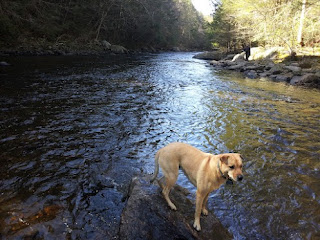
The river is constant. The river gurgles, hisses, and swooshes just as the wind slips through the bare branches on the trees. The river is rhythmic; the same white riffles twist and turn over and over and over. The river is mesmerizing as it shimmers in the changing light and slides by your feet.
The river seduces. Wade in and feel its cool power along your legs. The river is electric. It won't let you hold onto a moment because just as it was there, it is gone. Constant motion.
Salmon River Trout Management Area
My dog made her way out to this rock. She loved the process. She got to the rock and looked around like a queen. She faced the river and was in control. Then, she froze. The angle of the rock combined with the deceptive speed and movement of the river was too much. She panicked. She froze and whimpered. She was stuck.
Eventually, I waded back over and carried her to the bank.
As I stood there and fished, I got to thinking about her experience. She never waded more than two feet into the river the rest of the day--she stuck to the bank and enjoyed herself alongside the river. She learned something about herself and she learned something about that river. And, she was at peace with both.
"Good for her," I thought. She took a chance; she lived an intense moment. She now has a better understanding of her relationship amongst the river.
Maddock Douglass describes his Three Types of People to Fire for Businessweek.com. I agree and anyone that works closely with any team knows that those three types of people crush innovation.
Cocoon's Bernie Lefkowitz
However, I feel like these people Douglass describes can all be lumped together into one category as the victims, the nonbelievers, and the know-it-alls are all in the same part of the pool (or not even in the pool)--like Bernie Lefkowitz from Ron Howard's Cocoon. Bernie embodies qualities of all three.
South Park's Stan Marsh and Kyle Broflovski
There are two other groups of people on a team, though, that can contribute to or counteract innovation. The second group are opportunists. They enjoy status quo. They enjoy routines. They enjoy predictability. They do their jobs and they do them well. At times, they may fall into a funk and at others, they can be creative and innovative. They are the contemporary everyman--they can be dynamic and altruistic, yet struggle with self-fulfillment. Really, they are Stan Marsh and Kyle Broflovski.
Chris Chambers from Stand by Me
The last type is less common and not every team will have one every year--the Chris Chambers of the world. This person has an uncanny ability to form goals and achieve goals while motivating those around them. They fluctuate between confidence and over-confidence. This person is driven, yet discontented; they often accomplish the seemingly impossible, but also charge into problems without considering casualties. They will inspire Bernie Lefkowicz, but they will also abandon him. They will earn Stan's and Kyle's allegiance, but they will also isolate them for their hesitancy.
Most teams seem to have a lot of Bernies, a handful of Stans and Kyles, and find a Chris Chambers every now and then. As their leader and manager, you need to identify all three types and evaluate what each type brings to your team. What is each type of person doing for the current climate and what can they do for the future? Know the personalities of the people around you and keep building a culture for success.
Seamus Heaney has ability to find meaning in something otherwise overlooked.
One of my favorite's of his is Field of Vision, which ends with these two stanzas:
Face to face with her was an education Of the sort you got across a well-braced gate-- One of those lean, clean, iron, roadside ones Between two whitewashed pillars, where you could see
Deeper into the country than you expected And discovered that the field behind the hedge Grew more distinctly strange as you kept standing Focused and drawn in by what barred the way.
There are two distinct things going on here as the narrator stands and studies his nearly catatonic aunt. He sees a life well-lived in his aunt's face--a life full of experience.
He also realizes that he, too, is becoming catatonic through his pensive examination of this field that expands out further and further and becomes more strange and unusual.
What the narrator needs to do is get on up over this gate. The fear, uncertainty, introspection, and hesitation he feels is all just part of living, but only if he is actually living.
This is his turn to make the Next Play and educate himself.
Teachers and coaches everywhere wish you the best. As we have all taken new jobs, first jobs, difficult jobs, we came up with a few things to get you started as you finish your time with New England.
1. People that do not know you are already evaluating based on what they've heard. Where did you grow up? Where did you play? What did you do last?
These are all questions they are grinding down over coffee while you get ready for the Broncos. Penn State fans and your new colleagues think they know you.
2. People will talk about you every time you leave the room.
People will re-evaluate you every time they speak with you, see you on campus, or see you on T.V. Be mindful. Control your emotions. Treat everyone the way you would want your grandparents to be treated by the mechanic. Honesty, patience, and understanding are crucial.
Most people generally advise the same things about a new job. But, teachers and coaches our here want you to know how important it is going to be for you to build early relationships. We've all found that secretaries and grounds crews are the best people to befriend. They are the magic mirrors that will tell you all you need to know while everyone else is scrambling and playing their own games behind smiles and hand shakes that may linger just a bit too long.
3. Upper management and administration always have other options.
Your are replaceable; we are all replaceable. The guy's over at ESPN all seem to be writing that you may not have even been the best candidate. You got the job, so forget that nonsense. Just be careful--I'm not sure you can aggressively coach up Matt McGloin like Tom Brady.
4. People depend on you.
Yes, people in Red Sox Nation and Patriot Nation depend on you...but really Belichik and Brady will be the faces of this post season.
Though at University Park, students at the bars, alumni, youth football teams across towns, moms, dads, parents of your student athletes...the list goes on forever. Be a role model and be open to all of the people that are watching. As the St. Andrew's School (RI) basketball coach Michael A. Hart always says, "Be a helper."
5. Culture is uncanny.
You will need to give up some of Bill O'Brien and become part of Penn State before Penn State gives up some of itself to allow the Bill O'Brien era to begin. Pick one or two things a year to work on making your own. Building and changing culture is uncanny.
Best of luck Coach,
Coaches and Teachers world wide
Over the years I've taught and coached for a diverse range of schools and teams. Two things that remain constant, though, are staff meeting agenda items about a desire to build a culture of success and a mix of effective leaders.
Coach Walsh introduces an idea in his blog that "someone who leads by example doesn't lead." I don't necessarily agree with this statement that, admittedly, is out of context. So to re-contextualize the statement, I believe the first step of leadership is modeling a behavior of growth. Leading by example is the first step over the line the separates a leader from the rest of the team. I would say a good teammate, in athletics or in the workforce, shows up on time, displays a positive attitude, and displays a willingness to exert energy towards the goals of the team. If a person doesn't do these things or cannot do these things, then their time with that team has come to an end and they need to leave, or be asked to leave.
A leader, though, needs to lead by example because they have transcended those basic attributes of a good teammate and are now becoming agents of change. A good leader seeks out innovations that can improve the team. A good leader spends time every day reflecting on the performance of their team and tries something new to spark improvement. A good leader is never satisfied--even with success.
I am inspired every time I watch Coach Boone give this speech. "We will be PERFECT in every aspect of the game."
A good teacher leader will look at test scores, for example, and acknowledge scores that meet No Child Left Behind benchmark goals are great, but will then look for ways to EXCEED those benchmarks.
A good leader in athletics doesn't just prepare for the best opponent on the schedule, but seeks to move their team to perfect execution in all aspects of the game.
The overlooked second step of a strong leader is the development of a common, success-driven vocabulary for their team. Some words I loath and feel are detrimental forces to the quest for perfection are meeting, tutoring, remediate, accommodations, modifications, extended time, practice, and role.
Don't say meeting when an effective leader means collaboration.
Don't say tutoring or remediating when an effective leader means accelerating.
Don't say test-accommodations or test-modifications when an effective leader means test-scaffolding.
Don't say extended time when an effective leader means flexible scheduling.
Don't say practice when an effective leader, like Coach Boone, says, "let's go to work."
And coaches, please don't tell your team that everyone has a role when an effective leader means everyone is vital to the quest for perfection.